Hamilton Speech, University Funding Changes, And Other Thoughts


Today, this post covers:
- OSAP changes and university/college funding
- A Hamilton fundraiser and my Q&A with Storeys
- My thoughts on Robyn Urback’s compelling column on Canada’s fertility crisis
- Our March 3rd event with UofT professor Joseph Steinberg on Corporate Welfare/Industrial Policy (Sign up for in person or stream it live!)
1. A Better Path for Students and Universities
This week, the provincial government announced changes to university and college funding.
Tuition will increase by 2 percent annually for the next three years, and then by the lesser of 2 percent or inflation thereafter. After being frozen since 2018, this modest flexibility is better than continued suppression, but it still leaves institutional funding structurally below inflation over the long run.
The government also committed an additional $1.6 billion per year to colleges and universities. That funding covers roughly half of what institutions had been requesting. I am pleased to see new dollars flowing into the system.
The real issue, however, is how this is being paid for.
Changes to OSAP will significantly reduce the grant component available to students. In recent years, eligible students could receive up to 85 percent of their assistance as grants, with many seeing grant levels in the 60–75 percent range. Under the new framework, grants will be capped at 25 percent, with the balance delivered as loans.
In other words, we are backfilling institutional funding by shifting more debt onto young people.
I believe this is the wrong trade-off.
Young Ontarians are already living through what I have called a Milestone Recession. Education takes longer. Housing is further out of reach. Stable careers are harder to secure. Marriage and family formation are delayed. Now, we are adding more debt at the front end of adulthood, even as graduates enter one of the weakest job markets Ontario has seen in years.
Ontario’s unemployment trend has been uniquely poor within Canada, and that predates recent global shocks. We should be making it easier to start and build a life here, not harder.
If we were serious about structural reform, we would have taken a different path: fully unfreeze tuition, allow institutions to price programs in line with quality and demand, and pair that with significantly increased direct grants to students or forgivable, zero-interest loans (I’ll have more to say on this specifically). Let students decide what is worth it. Students are the best judges of value.
That would put both institutions and young people on sustainable footing.
2. From me: Speech in Hamilton and Q&A with Storeys
On Thursday, I joined members from several Hamilton-area PLAs for a Valentine’s themed fundraiser.It was the first time all prospective leadership candidates shared a stage together.
Hamilton is a city that understands the difference between rhetoric and results. My remarks focused on one central theme: Ontario has been stuck in managed decline for decades. We have extraordinary advantages, yet our productivity, growth, and competitiveness have lagged. We have normalized underperformance.
That has to end.
You can watch the full speech here:
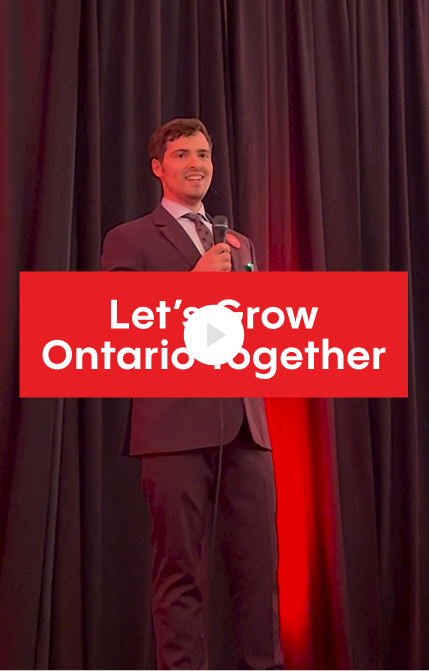
What’s more, I also had the pleasure to do a Q&A with Storeys. Ontario has some of the weakest housing conditions in the country and I think we can do a lot better. You can check out the piece here.
3. Families, Fertility, and Generational Fairness
On Saturday, Globe and Mail columnist Robyn Urback published a thoughtful piece on Canada’s fertility crisis. She argues that cultural change is central to reversing the trend. I agree that culture matters. But culture does not have space to change if policy does not lead.
Policy alone will not fix declining fertility. But if public policy is not child- and family-friendly, cultural change becomes nearly impossible.
Over the last generation, public policy trade-offs have fallen disproportionately on young people. The result is a Milestone Recession:
- Longer education.
- Higher debt.
- Delayed homeownership
- Slower income growth relative to housing costs.
- Later family formation
- Higher taxes to sustain a welfare state that primarily benefits retirees.
Add geopolitical instability, rapid technological change, and climate anxiety, and it is not surprising that many young people are postponing or forgoing children, often against their own preferences.
So what do we do?
First, fix housing. A median family should be able to afford a three- or four-bedroom home by age 30. That means radically increasing supply, reforming zoning and building codes, and making family-sized urban housing abundant and affordable. It also means enabling people to live near their support networks. Housing scarcity fuels rat-race anxiety that begins in high school.
Second, fix the economy. A fast-growing, high-productivity economy reduces uncertainty and builds optimism. People are more willing to take life risks, including having children, when they believe the future is brighter than the present.
Third, help young families build stability earlier. I support income splitting for married couples under 35 and households with children. I also believe the first portion of lifetime earnings should be tax-free to allow young adults to save and invest earlier. These measures should be paired with flexible childcare and education supports.
Fourth, make public spaces safer and more family-friendly. In too many urban debates, children are an afterthought. They should be central.
Immigration is important. But it is not a substitute for a coherent demographic strategy. We cannot indefinitely import our way out of structural problems.
4. Join us March 3rd to talk Corporate Welfare
I’m hosting an in person conversation on Tuesday March 3 at 6:30 pm at Studio 535 just east of downtown in Toronto. The topic is “Ending Corporate Welfare And Doing Industrial Policy Right”, and I’ll be joined by Joseph Steinberg, an economics professor at the University of Toronto. We’ll map Ontario’s subsidy landscape across direct, indirect, and regulatory supports, dig into what we get wrong, the real costs and trade offs, and what a better pro growth approach should look like.
Details:
- Hosted by Studio 535 at 535 Queen East, Toronto.
- Tuesday March 3 at 6:30 pm
- 20-30 minute interview followed by 20-30 minute audience Q&A
Check out all the details on LUMA
—-
If you have not yet signed up, I encourage you to do so here and join an upcoming call.
If you or someone in your network is open to being a major donor, please reach out. If you would be willing to host an event in your community, we would be glad to attend. And if something is happening in your area, let us know. We are building a campaign that shows up.
Ontario can do better. The question is whether we are willing to build it.


